Private AI tuition

Private tuition withAgra’s Shashank Agarwal.

₹3,499 a month.

Shashank Agarwal
Mathematics
13years teaching
5000+students taught

M.Sc. (Mathematics)

Boards
CBSEICSEIBIGCSE
Student results

Helped students achieve 100% in CBSE/ICSE, A* in IGCSE

A little lesson withShashank Agarwal
xy
FIG. 01 / THE SHAPE OF AN ANSWERIllustrative model
Can you make it touch just once?

Move the curve. Watch where it meets the axis.

Below the axisAbove the axis
y = x² + c
Your first little lessonMaths / Quadratics

Shashank asks:One curve. Two answers.
Can you make it just one?

Take a guess. Being wrong is a perfectly good place to start.

Samajha / Interactive lesson preview
The teacher behind your tutor

A familiar way
to understand.

An AI copy, built in collaboration with your teacher. He understands how Agra learns.

MathematicsAgra13 years teaching
Step into a class
From your teacher
“Mathematics becomes easy when you understand the logic behind it.”

M.Sc. (Mathematics)

Meet the teacher +

I am a dedicated mathematics educator with years of experience teaching, mentoring, and creating content across international and national curricula. I focus on building conceptual clarity and confidence through doubt-solving and structured test prep for students of Grades 9 to 12. I offer online and offline 1-on-1 and batch classes, focusing on high-quality learning experiences, strong academic systems, and helping students reach their full potential.

Teaching background

students taught
5000+
Boards
CBSE, ICSE, IB, IGCSE
Results
Helped students achieve 100% in CBSE/ICSE, A* in IGCSE, and
Experience
13 years of teaching experience

Teaching record supplied by your teacher.

01

A teacher’s method.

How to open a chapter. What to ask when a student is stuck. When to try a different explanation.

02

A tutor of your own.

That way of teaching, in an AI tutor that asks, listens and works with one student at a time.

03

Built together. Endorsed.

Your teacher built this with Samajha and endorses it.

You are learning with an AI copy of your teacher, built in collaboration with Samajha.

01 · The difference

An answer lasts
a moment.
Understanding
stays.
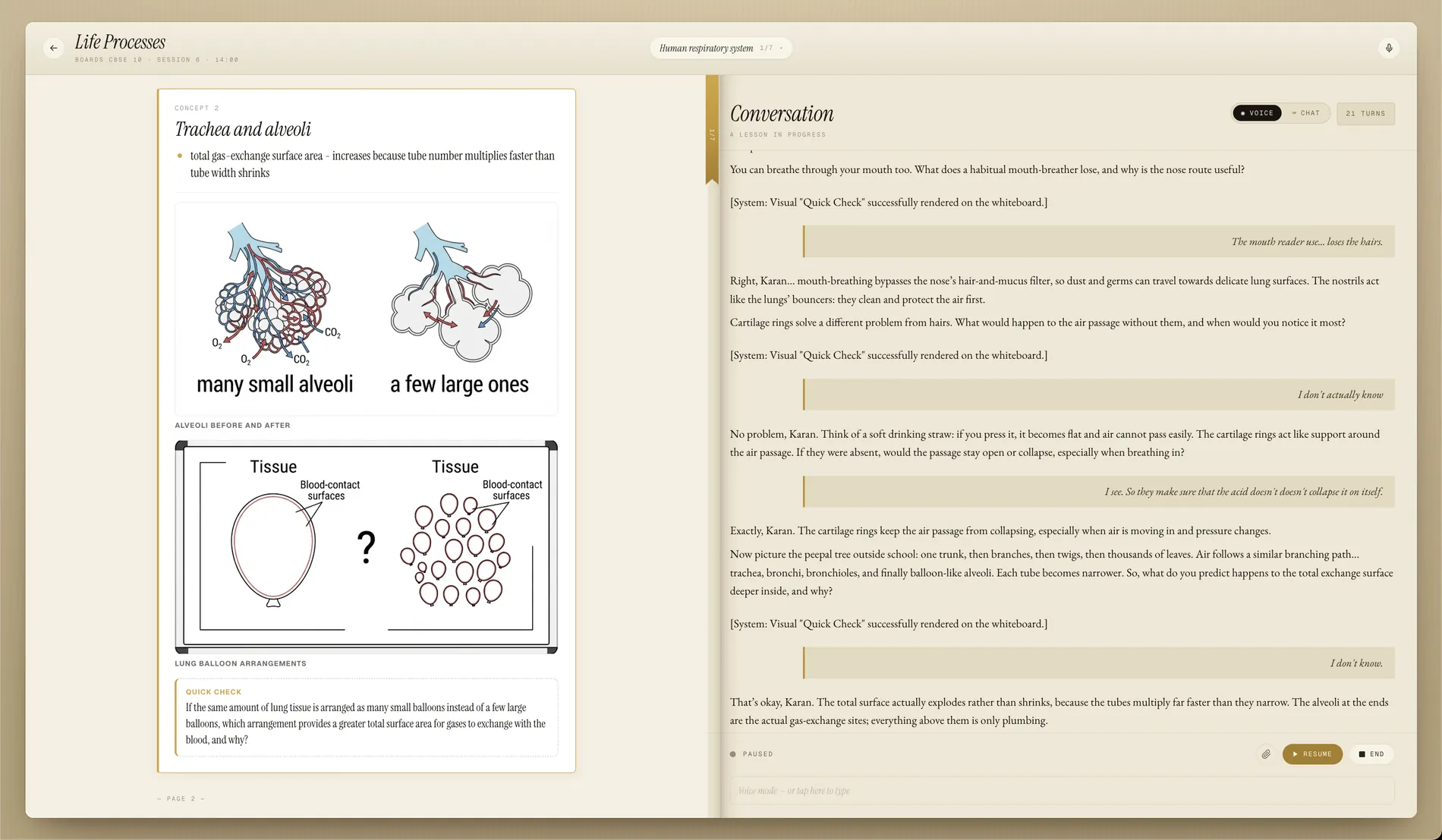
Actual Samajha tutoring interface: a populated whiteboard beside the spoken lesson conversation.
The actual classroom See it in motion ↓

Your tutor asks, listens and tries a different explanation until you can explain it back.

Less “learn this.”
More “let’s see why.”
02 · A voice, not a text boxSound on. Shoulders down.

Think out loud.
Someone’s listening.

Your AI tutor leads a one-to-one lesson in English or Hinglish. Talk, type, and work it out on the whiteboard.

Quadratic Equations

CBSE 10 · Class preview
Concept 2

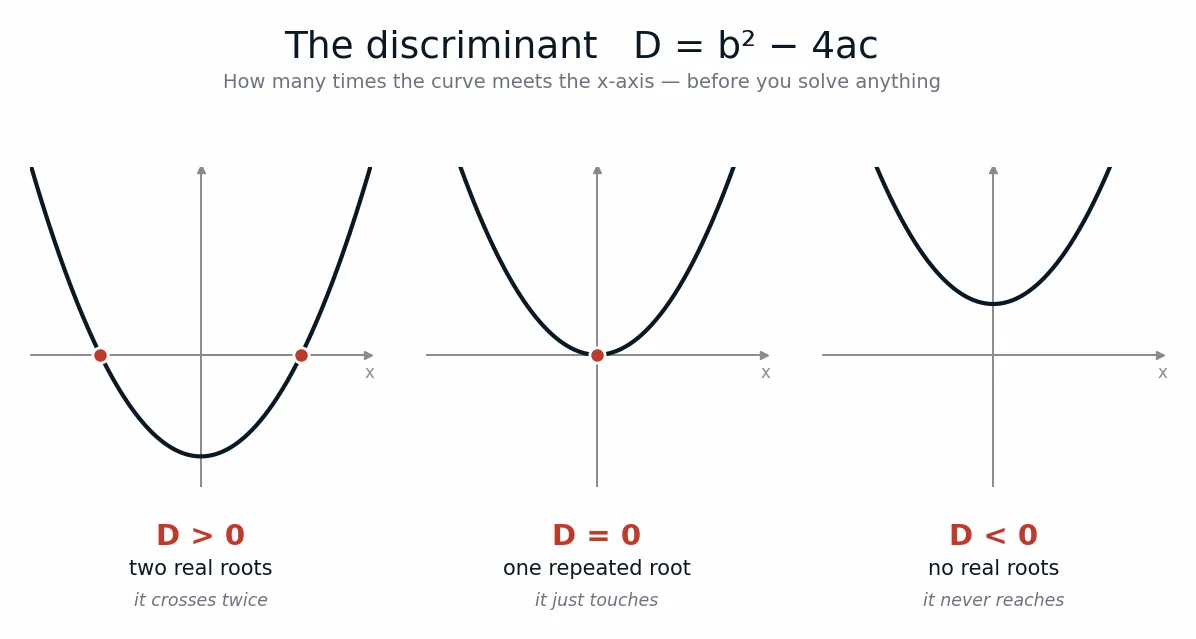
The discriminant

    The board fills as the conversation unfolds.

    Your chapter notes

    Conversation

    The complete recorded demo
    Tutor speakingVoice

    Rule one for quadratics. You can know how many answers exist before you find a single one.

    1 / 12
    Watch the notes appear
    Before class

    Planned, move by move.

    Questions, analogies and likely wrong turns, planned before class.

    During class

    A way that fits you.

    Past classes and your reasoning shape how the tutor teaches you next.

    After class

    The board stays yours.

    Every definition, equation and diagram becomes your chapter notes.

    Your turn. Talk to the tutor live ↗No sign-up or card needed to try.
    In partnership withsmallest.aiRecipient of the smallest.ai startup grant.
    03 · The thinking between classesA plan with a reason

    “What should I
    study today?”
    Already taken care of.

    You choose when you’re free. Samajha plans what’s next around school, exams, homework and the gaps holding you back.

    Riya / Class 10 / Illustrative week

    Change her week.
    Watch the plan think.

    A week with room to learn, practise, and remember.

    What goes into this plan +
    Exam horizon211 days to boards
    School’s paceFinishing Chapter 8
    UnderstandingTrigonometry · 41%
    HomeworkTuesday’s is due
    Exam techniqueTimed answers need work
    What’s fadingQuadratics, last seen in June
    Her availabilityWeeknights after 7 · Sat 10 am
    Her diaryNext week is clear
    The week it buildsReady for the week
    The bigger picture

    On pace to finish by 12 December, ahead of school.

    Every class has to earn its place. Planned around prerequisites, school progress, exam dates and marks, homework, memory and your time.

    04 · A routine that carries youLess deciding. More doing.

    A class to turn up to.
    Not another app to open.

    A week in the life / Example

    Riya’s week.

    01 / Your time
    Week playingBuilding the week
    Mon7 pm
    Time set
    TueAt home
    Your own time
    Wed7 pm
    Time set
    Thu7 pm
    Room to adjust
    Fri7 pm
    Time set
    Sat10 am
    Time set
    SunA day off
    Room for life.
    You choose when.

    Around school, cricket, dinner. Samajha takes it from here.

    Your timesClassesReminderRescheduled

    Six kinds of class.
    One job: move you forward.

    What happens next depends on what happened last.

    01TeachingThe next idea that matters.+

    An important subtopic, explained aloud and drawn on the board. Then a question to check understanding.

    A little working, together
    x² + 5x + 6 = (x + 2)(x + 3)

    “Which two numbers multiply to six and add to five?”

    02HomeworkYour working tells the story.+

    Work on paper, upload a photo. The tutor marks your steps, notices where you needed help, and plans the next class.

    Write itPhotograph itLearn from it
    03Doubt classYesterday’s wrong turns, untangled.+

    Wrong answers and hints become the next lesson, focused on the misunderstanding behind the mistake.

    04PracticeUntil the shaky bit feels steady.+

    Questions at your level, focused on subtopics that need practice. No new material.

    05Mock paperMeet the exam before exam day.+

    Timed, real board questions matched to the marking blueprint. Practise the knowledge and the pressure.

    06Catch-upFifteen minutes to find your footing.+

    A short check-in: how you’re doing, what got in the way, and what needs adjusting.

    05 · Built before you askDepth takes time

    The conversation flows.
    The preparation runs deep.

    Weeks of preparation behind each lesson: explanations, analogies, likely wrong turns and ways back. All mapped to your syllabus.

    1,148Curated lessons

    Teacher-planned, move by move.

    27,517Exam questions

    Board papers and NCERT Exemplar, mapped to chapters and marks.

    18,611Lines of syllabus

    Topics, subtopics, prerequisites and their marks.

    Inside the lesson library

    A syllabus, made teachable.

    001The Fundamental Theorem of Arithmetic
    002Area of a segment of a circle
    003Median of grouped data
    004Geometrical Meaning of the Zeroes of a Polynomial
    005Algebraic Method: Elimination
    006Word Problems Leading to Quadratic Equations
    007Similar figures and similarity of polygons
    008Section formula and mid-point
    009Single-triangle heights and distances
    010Effects of oxidation in everyday life
    011Refraction of light and Snell's law
    012Sign convention
    013Atmospheric refraction
    014Resistance, resistivity, and factors
    015Magnetic field and field lines
    016Domestic electric circuits
    017Food chains and food webs
    018Chemical properties of acids and bases
    019Physical properties of metals and non-metals
    020Basic metallurgical processes
    021Homologous series
    022Dobereiner's triads
    023Nutrition, autotrophic and heterotrophic
    024Transportation in human beings
    025Human brain
    026Asexual reproduction
    027Menstrual cycle and hormones
    028Evolution, evidence
    029Significance of Mitosis
    030The C3 pathway (Calvin cycle)
    031Glycolysis
    032Growth phases, rate, and conditions
    033Respiratory organs and the human respiratory system
    034Blood
    035The human excretory system
    036Types of movement
    037The neuron and the nervous system
    038Endocrine glands and hormones
    039Kingdom Protista
    040Algae
    041Plant life cycles and alternation of generations
    042The inflorescence
    043Tissues: Meristematic and Permanent
    044Organ and Organ System
    045Cell Organelles
    046Proteins and the Structure of Proteins
    047SI units
    048Percentage composition, empirical and molecular formulae
    049Bohr's model for the hydrogen atom
    050Genesis of periodic classification
    051Periodic trends in ionization enthalpy
    052The VSEPR theory
    053Work, heat, and the first law of thermodynamics
    054Gibbs energy and equilibrium
    055Le Chatelier's principle
    056Solubility product
    057Redox reactions and electrode processes
    058Isomerism, structural and stereoisomerism
    059Classification of hydrocarbons
    060Aromatic hydrocarbons, EAS mechanism
    061Venn diagrams
    062Standard equation of a circle
    063Coordinates of a point
    064Limits of polynomial and rational functions
    065Chain rule
    066Variance and standard deviation
    067Exhaustive and mutually exclusive events
    068Relations: domain, codomain, range
    069Composition of functions
    070Graphs of trig functions
    071Need for complex numbers
    072Quadratic equations in the complex system
    073Fundamental principle of counting
    074Arithmetic mean
    075Slope and angle between lines
    076Significant Figures
    077Measurement of temperature
    078Change of state
    079Heat, internal energy, and work
    080Second Law of Thermodynamics
    081Kinetic theory of an ideal gas
    082Simple harmonic motion
    083The simple pendulum
    084Reflection of waves
    085Scalars and Vectors
    086Motion in a Plane
    087The Law of Inertia
    088Equilibrium of a Particle
    089The Conservation of Mechanical Energy
    090Motion of centre of mass
    091Equilibrium of a rigid body
    092Kepler's laws
    093Gravitational potential energy
    094Hooke's law
    095Streamline flow
    096Microsporogenesis and megasporogenesis
    097Post-fertilisation: endosperm and embryo
    098Transgenic animals
    099Organisms and environment: abiotic factors
    100Ecosystem structure
    101Nutrient cycling: carbon and phosphorus
    102Conservation: in situ and ex situ
    103Fertilisation and implantation
    104Sexually transmitted infections
    105Multiple alleles and ABO blood groups
    106Mendelian disorders: sickle-cell, PKU, thalassemia
    107Lac operon and gene regulation
    108Adaptive radiation
    109Cancer, types, causes, diagnosis
    110Microbes in biogas production
    111Vectors, pBR322, Ti plasmid
    112Downstream processing
    113Positive and negative deviations
    114Enzymes
    115Nernst equation and its applications
    116Electrolysis and Faraday's laws
    117Rate law and rate constant
    118Arrhenius equation and activation energy
    119Actinoids and the lanthanoids
    120Bonding in complexes: VBT and CFT
    121Substitution Reactions, SN1 and SN2
    122IUPAC Nomenclature
    123Oxidation Tests and Reduction of Carbonyls
    124Distinction Tests for 1°, 2° and 3° Amines
    125Types of vectors
    126Vector (cross) product
    127Bayes' theorem
    128Operations on matrices
    129Differentiability
    130Rate of change of quantities
    131Integrals of some particular functions
    132Definite integrals by substitution
    133Variables separable
    134Superposition principle
    135Huygens' principle
    136Polarisation, Malus' law, Brewster's law
    137Rutherford's alpha-scattering experiment
    138Binding energy per nucleon
    139Band theory, conductors and semiconductors
    140Zener diode as voltage regulator
    141Conductors and insulators
    142Kirchhoff's rules
    143Ampere's circuital law, solenoid, toroid
    144Moving coil galvanometer
    145Faraday's laws of electromagnetic induction
    146AC generator
    147Power in AC circuit and power factor
    148Combination of thin lenses
    149Lakhs, crores, and the Indian place-value system
    150Recap of integers and the number line
    151Lowest common multiple
    152Estimation with decimals
    153Geometric constructions
    154A short history of equation solving
    155The need for smaller units
    156Addition and subtraction of decimals
    157Patterns using letter-numbers
    158Corresponding angles
    159Explorations in number grids
    160Constructing triangles given some sides and angles

    Real lessons. Each with its own teaching plan.

    Why we start with fewer things

    Go beyond
    the surface.

    A topic is one line.
    Teaching it is a sequence of decisions.

    Fewer subjects. Weeks spent planning a chapter, move by move.

    One topic. A carefully prepared path.
    A deep syllabus. An honest boundary.CBSE

    Classes 6–12.
    Maths & the sciences.

    In development: English, Hindi, Social Science and Computer Science. Family demand helps decide the order.

    Another subject or board? Ask where it’s in the queue ↗
    06 · For the person who cares mostYou get to be the parent

    Know how it’s going.
    Without running the show.

    Your parent account shows progress, missed classes and homework. The tutor handles the planning and follow-through.

    Your parent account / Example

    Here’s where
    Riya is.

    Class 10
    This week
    Attendance4 attended · 1 missed and moved
    What she studiedTrigonometry 8.2; tangent from an external point
    Homework8 questions set · 5 correct · 3 to revisit
    Needs attentionTwo-tower problems; timed practice
    Syllabus paceFinish: 12 Dec · ahead of school

    Ask what you actually want to know.

    She can use trigonometric ratios, but setting up two-tower problems is still difficult. Her next doubt class revisits the three homework questions that exposed the gap.

    One thing you won’t see

    Her private conversations.

    See progress, not private conversations or lesson transcripts. Your child has room to say “I don’t understand.”

    07 · Make room for a little more “oh.”

    A private tutor.
    A different kind
    of tuition bill.

    3,499
    a month · your own AI tutor
    5 classes every week
    CBSE · Classes 6–12
    At your pace. On your schedule.
    • Full syllabus · all supported subjects
    • Private voice + text tutoring
    • Your times · a plan that adapts
    • Homework set, marked, and followed up
    • Board-style mock papers
    • Your own parent account
    • Chapter notes from the whiteboard
    Find your “oh.” Meet Shashank’s clone
    No sign-up to try. No card to start.

    Your free account includes five full classes in total, with the first two sections of each chapter available. Paid plans open the full syllabus.

    10-day full refund
    From the start of a billing month.
    Cancel in your account
    No call. No lock-in.
    No loans. No EMIs.
    Just a monthly decision.
    Put it beside your tuition bill

    The fee is only half the comparison.

    Group tuition · one subject

    ₹5,000 is an example. Enter your own quote.

    A teacher’s attention, shared with a batch.
    Samajha Basic · all supported subjectsPer month₹3,499

    Five private AI tutoring classes every week.

    Your pace. Your questions. Your own study plan.

    ₹1,501 less per month than the fee you entered. Basic includes every supported subject.

    08 · Fair questionsPlain answers

    A few things
    you might be wondering.

    Will my child actually turn up?+

    Classes have a time, a reminder, and a plan that responds to missed work. Try the five free classes before deciding whether it fits your child. You don’t need to pay to find out.

    Do I have to sit beside them?+

    No. The tutor should handle the teaching and follow-through. If you still have to supervise every class, it isn’t doing its job. The ten-day refund gives you room to make that call.

    Why not just use ChatGPT?+

    A chatbot answers questions; Samajha teaches. It decides what you should study next, notices neglected topics, sets and marks homework, and turns the mistakes into your next class. It’s the difference between getting an answer and having a tutor.

    Is my child’s information private?+

    Parents cannot access lesson transcripts or private conversations. You get useful progress information while your child keeps a private space to think aloud.

    What if it doesn’t feel right?+

    You can get a full refund within the first ten days of a billing month. Cancel from your account whenever you want; there’s no phone call to make, loan to close, or long contract to unwind.

    Who’s behind Samajha?+

    Brittle Hollow Labs Private Limited, based in Mumbai. The founder still helps set up most families. The WhatsApp link below reaches a real person; the team aims to reply the same day.